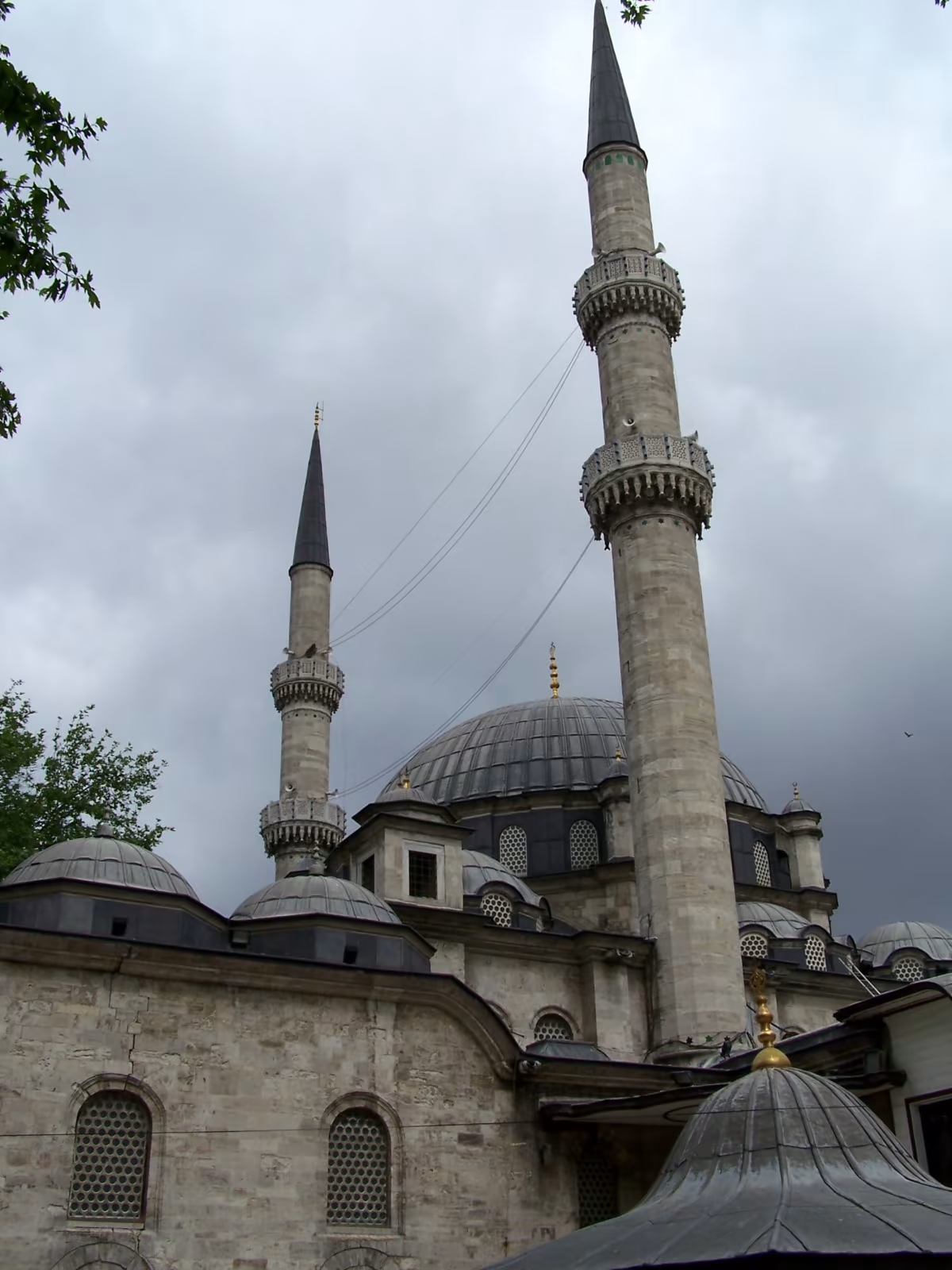
The Eyüp Sultan Mosque is situated in the Eyüp district of Istanbul, outside the Walls of Constantinople on the shores of the Golden Horn. The complex includes the mausoleum where Abu Ayyub al-Ansari, the standard-bearer and companion of the prophet Muhammad, is said to be buried. Occupying a much older site, the present building dates from the beginning of the 19th century. Because of its particular sanctity, the mosque played a key role in coronation ceremonies, where new Ottoman Sultans came along the Cülus Yolu to be girded with the Sword of Osman.
The mosque is named after Abu Ayyub al-Ansari, who is believed to have died here during the first Arab siege of Constantinople in the 1670s. A complex was constructed on the site in 1458 by Sultan Mehmed II just five years after the conquest of Constantinople. According to legend, Mehmed II located the burial place after his teacher Akşemseddin had a dream and found a white mermer inscribed with al-Ansari's name. Mehmed II then ordered the area to be enclosed and built the mosque next to it.
Throughout its history, the structure underwent various repairs. Sultan Ahmed III rebuilt the two minarets in the early 18th century. By the end of the 18th century, likely due to earthquake damage, the mosque was in a ruinous state, prompting Sultan Selim III in 1798 to order the entire structure except the minarets to be pulled down and rebuilt. This work was completed on July 7, 1800. The eastern minaret was later rebuilt in its original style by Mahmud II in 1822.
As a companion of Muhammad, Abu Ayyub al-Ansari is deeply venerated, making his tomb a site of paramount importance. The mausoleum sits on the north side of the inner courtyard opposite the prayer hall's main entrance and houses relics believed to have belonged to Muhammad. Due to the extreme holiness attached to the mosque, many Ottoman officials and royals, including Sokollu Mehmet Paşa, Siyavuş Paşa, Lala Mustafa Paşa, Âdile Sultan, and Mihrişah Sultan, chose to be buried nearby. Additionally, the tomb of Sultan Mehmed V, designed by Mimar Kemaleddin Bey in 1918, overlooks the water nearby.
Despite its relatively late reconstruction date, the Eyüp Sultan Mosque remains faithful to the Classical Ottoman architectural style popularized by Mimar Sinan in the 16th century. It follows the "octagonal baldaquin" design featuring a central dome surrounded by semi-domes, comparable to Sinan's Sokollu Mehmed Pasha Mosque. Much of its decoration displays the contemporary Ottoman Baroque style with engaged columns, carved foliate and shell shapes, and calligraphic inscriptions. The building is primarily constructed of white stone with brass-bound white marble columns.
Externally, an irregular outer courtyard leads to a rectangular inner courtyard. An elevated enclosed corridor on the south side of the outer courtyard originally served as the sultan's private entrance. An old plane tree stands in the middle of the inner courtyard on a platform with Baroque marble fountains at its corners; this platform was historically where Ottoman sultans were girded with the Sword of Osman. The walls facing the portico are adorned with Iznik tiles featuring the characteristic sealing-wax red glaze from around 1580.
The mosque was once the center of a larger külliye that included a medrese, an imaret, and a hamam. While the medrese was likely demolished during the reconstruction, much of the hamam has been preserved and now operates as the Eyüpsultan Türbe Hamamı Müzesi. Other surviving structures in the vicinity include the imaret and tomb complex of Mihrişah Sultan.
In modern times, the mosque remains a vibrant destination. Families often bring boys in special attire ahead of their circumcision ceremonies, and mass circumcision sessions are organized here. During Ramadan, it serves as a popular gathering place to break the fast with picnics in the courtyard, while year-round it remains a major pilgrimage destination for visitors from across the country.
Wikimedia research dossier · Last checked: 2026-09-25 15:03:14


